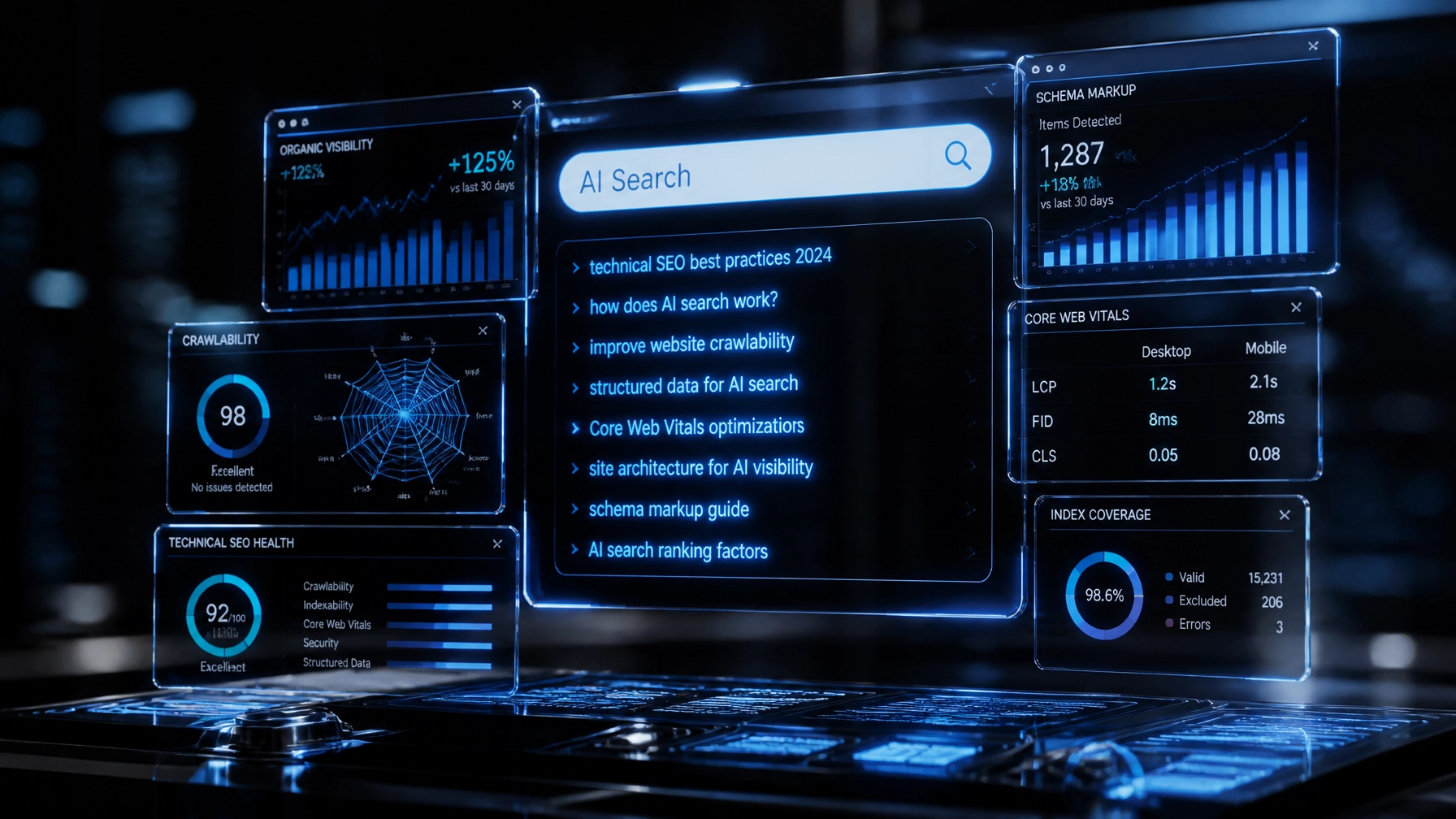
The contemporary digital landscape has undergone a radical transformation as the traditional paradigm of the search engine results page yields to the sophisticated architecture of the intelligent search box. As generative artificial intelligence becomes the primary interface through which information is consumed, the fundamental objectives of digital visibility have shifted from mere indexation to active citation. Organizations must acknowledge that the historical reliance on blue-link visibility is no longer sufficient; rather, a website must now establish itself as a verifiable, authoritative source that Large Language Models (LLMs) can parse, validate, and reference with high confidence. Consequently, the deployment of advanced technical seo services has emerged as the pivotal mechanism for maintaining relevance in an era characterized by autonomous AI agents and generative overviews.
By understanding the mechanics of how these intelligent systems retrieve information, businesses can proactively align their digital infrastructure to satisfy the stringent requirements of machine-readable authority. This transition necessitates a departure from superficial optimization toward a more profound integration of semantic clarity and structural integrity. As the competition for the single "answer box" intensifies, the following five technical refinements represent the strategic evolution required to transform a standard website into a citable digital entity.
1. Advanced Semantic Schema: Moving Beyond the Fundamentals
The proliferation of semantic data has rendered basic schema implementations inadequate for organizations seeking to maintain a competitive advantage in AI-driven search environments. While standard markup provides a baseline for recognition, advanced technical seo services now focus on the intricate layering of nested properties and external identifiers that allow AI agents to connect specific content to established global entities. By utilizing precise vocabularies: such as "sameAs" properties that link to Wikidata or authoritative industry databases: organizations can resolve ambiguity and confirm their identity within the broader knowledge graph. This depth of semantic detail is paramount, as it provides the explicit confirmation required for an AI to cite a website as a definitive source for specific facts or services.
Furthermore, the integration of specialized schema types, such as "HowTo," "FAQPage," and "Service" markup, allows for the granular breakdown of complex information into digestible, machine-readable components. When structured correctly, these data points serve as the scaffolding upon which generative engines build their responses, thereby increasing the likelihood of a direct citation within an AI overview. The objective is to create a seamless synergy between the visual content intended for human consumption and the underlying data layer designed for algorithmic interpretation. As such, the technical rigor applied to schema deployment has become a primary differentiator for brands seeking to rank in AI overviews and maintain authority in a fragmented search landscape.

2. Structural Optimization for Answer Engine Compatibility
The evolution of search has necessitated a fundamental reconsideration of content hierarchy, whereby information is parsed not only for topical relevance but also for its utility within a conversational context. AI agents frequently prioritize content that is structured to provide immediate clarity to complex inquiries; therefore, the implementation of "answer-first" layouts has become a critical component of modern technical seo services. This approach involves the deployment of semantic HTML tags: such as H1 through H4: in a logical, cascading order that mirrors the cognitive processing of an intelligent reader. By providing clear, concise summaries followed by deeper analytical data, organizations enable AI crawlers to efficiently extract the necessary insights for their generated summaries.
Moreover, the strategic use of list structures, data tables, and defined glossary terms provides the structural clarity that generative engines require for accurate information retrieval. This meticulous attention to document architecture ensures that the most pertinent information is easily accessible, thereby reducing the computational effort required for an AI to synthesize the page's content. As organizations embrace this structural shift, they not only improve their chances of being cited by search boxes but also enhance the overall user experience for human visitors who value clarity and precision. The alignment of technical structure with linguistic intent is no longer an optional refinement but a core necessity in the new era of the intelligent search box.
3. The Speed of Citation: Performance as a Credibility Factor
In the high-velocity environment of generative search, the performance and responsiveness of a website’s infrastructure have emerged as critical proxies for reliability and authority. AI agents and their associated crawlers prioritize sources that demonstrate low latency and high availability, as these factors directly impact the efficiency of the retrieval-augmented generation (RAG) process. Comprehensive technical seo services now encompass deep performance tuning, including the optimization of server response times and the reduction of main-thread blocking, to ensure that content is delivered at the "speed of citation." When a search agent must choose between multiple authoritative sources, the technical stability and speed of the host environment often serve as the deciding factors in the final selection.
Additionally, the adoption of modern web frameworks and server-side rendering (SSR) ensures that content is immediately visible to bots without the need for complex, time-consuming client-side processing. This shift toward more efficient rendering pathways allows AI systems to crawl and understand the full scope of a site’s content without the risks associated with JavaScript execution delays. By eliminating technical bottlenecks, organizations foster a environment where their data is consistently accessible and verifiable by autonomous agents. In conclusion, the technical health of a website is fundamentally intertwined with its ability to serve as a reliable source in an increasingly automated information ecosystem.

4. Syntactic Alignment and Natural Language API Synchronization
As search algorithms transition toward a more nuanced understanding of human language, the alignment of website content with Natural Language Processing (NLP) models has become a pivotal focus for specialized technical seo services. Organizations must ensure that their technical documentation, service descriptions, and informational assets are crafted with a level of linguistic precision that aligns with how AI models categorize concepts and entities. This process involves the strategic use of entity-rich language and the avoidance of ambiguous phrasing that might confound a machine’s ability to categorize the content accurately. By leveraging tools that simulate the parsing behavior of major AI agents, businesses can refine their syntax to maximize the "confidene score" that search engines assign to their content.
Furthermore, the implementation of Natural Language API alignment allows for the identification of missing semantic links within a content body, enabling the addition of context that clarifies the relationship between various topics. This proactive approach ensures that the website does not merely contain keywords, but instead exists as a coherent network of ideas that an AI can easily synthesize and replicate. This evolution in strategy allows organizations to unlock new levels of visibility, as their content becomes inherently more "quotable" for generative responses. While traditional SEO emphasized word frequency, the future of search is defined by the integration of AI-readable content and the technical frameworks that support it.

5. Entity-Based Site Architecture: The Knowledge Graph Strategy
The transition from a page-based hierarchy to an entity-based architecture represents the most profound shift in the contemporary application of technical seo services. In this model, the website is organized around distinct concepts, products, and services that are treated as nodes within a localized knowledge graph, rather than isolated URLs. By establishing clear relationships between these entities through sophisticated internal linking and categorical hierarchies, organizations provide a roadmap that AI agents can use to understand the full breadth of the company's expertise. This structural depth is essential for establishing topical authority, as it demonstrates a comprehensive understanding of a subject matter that transcends individual keyword targets.
Moreover, an entity-based approach facilitates the discovery of related content by search bots, thereby increasing the total "surface area" available for citation in various search contexts. As businesses develop these complex architectural frameworks, they move away from the limitations of traditional sitemaps and toward a more dynamic, interconnected digital presence. This evolution enables the organization to be recognized not just for what it says, but for the position it occupies within the global information landscape. Ultimately, the successful navigation of the intelligent search box requires a commitment to building a digital foundation that is as interconnected and intelligent as the systems that crawl it.

The journey toward becoming a citable authority in the age of artificial intelligence is an ongoing process of refinement and adaptation. As the boundaries between search and generation continue to blur, the importance of robust technical seo services will only continue to escalate. Organizations that embrace these five technical tweaks will not only survive the transition to the intelligent search box but will also emerge as the primary sources of truth in a digital world defined by machine-driven discovery. The future of the web belongs to those who possess the foresight to build sites that are not merely searchable, but inherently citable.