
Legal landing pages convert at an average of 6.4% across the industry, more than double the 2.35% benchmark seen across all industries. For law firms spending real money on Google Ads or SEO, that gap is the difference between a thriving intake pipeline and a budget that quietly bleeds out. If you’ve been sending paid traffic to your homepage and wondering why your phone isn’t ringing, this guide is for you. We’ll break down exactly what a landing page is, why legal professionals see outsized results from them, what the best ones are built from, and how to keep improving them over time.
Table of Contents
- Defining landing pages: A foundation for legal marketing
- Why landing pages convert: Legal benchmarks and performance drivers
- Essential components of high-converting legal landing pages
- A/B testing and continuous improvement for legal landing pages
- Perspective: Why most legal professionals still miss the real landing page opportunity
- Transform your legal marketing with proven landing page tactics
- Frequently asked questions
Key Takeaways
| Point | Details |
|---|---|
| Landing pages boost legal leads | Focused landing page strategies routinely outperform general web pages for law firms, driving higher conversion rates. |
| Small changes multiply impact | Tweaking headlines, reducing form fields, and refining CTAs can deliver double-digit conversion lifts. |
| Data and speed are your edge | Tracking every step and responding to inquiries quickly unlocks the full potential of landing pages for client growth. |
| Testing fuels growth | Continuous A/B testing ensures that your legal landing pages keep improving and outpace the competition. |
Defining landing pages: A foundation for legal marketing
A landing page is a standalone web page built around a single goal. That goal might be getting a visitor to book a free consultation, download a legal guide, or call your office. Everything on the page, the headline, the images, the form, the button, points toward that one action. Nothing else.
This is what separates a landing page from your homepage or a practice area page. Your homepage tries to do many things at once: introduce your firm, list your services, tell your story, and point visitors in several directions. A practice area page explains what you do. A landing page, by contrast, is built to convert. It strips away navigation menus, sidebar links, and anything else that might pull a visitor’s attention away from that one desired action.
Here’s a quick comparison to make this concrete:
| Page type | Primary goal | Navigation | Content focus |
|---|---|---|---|
| Homepage | Brand introduction | Full menu | Multiple services and audiences |
| Practice area page | Educate on a service | Full menu | One practice area |
| Landing page | Drive one specific action | Removed or minimal | Single offer or CTA |
In legal digital marketing, landing pages typically serve one of these goals:
- Consultation booking: A personal injury firm runs Google Ads targeting “car accident lawyer near me” and sends traffic to a page with one form and one phone number.
- Lead magnet download: An estate planning attorney offers a free will checklist in exchange for an email address.
- Event registration: A business law firm promotes a free webinar on contract basics for startups.
- Case evaluation request: A criminal defense attorney collects initial case details through a short intake form.
The volume of landing pages you build also matters. Firms with 40+ landing pages generate 12 times more leads than those with fewer than five. That’s not a small edge. It reflects how targeted, specific pages outperform general ones when a prospect is searching for exactly what you offer.
Think of it this way: a homepage is like a law firm’s reception area. A landing page is the attorney’s office where the real conversation happens. It’s focused, purposeful, and designed to move things forward. If you’re thinking about how landing pages fit into a broader growth plan, the same focused thinking applies to areas like exit strategy planning where every decision needs a clear objective.
Why landing pages convert: Legal benchmarks and performance drivers
The numbers for legal landing pages are genuinely impressive. Well-optimized legal pages reach 8% to 15% conversion rates, and the top 10% of legal landing pages convert at 11.2% or higher. Compare that to the all-industry average of 2.35% and you start to see why legal is one of the highest-performing verticals in digital marketing.

| Benchmark | All industries | Legal services |
|---|---|---|
| Average conversion rate | 2.35% | 6.4% |
| Top 10% conversion rate | 11.45% | 11.2%+ |
| Optimized page range | 5–10% | 8–15% |
Why does legal outperform? Intent. When someone searches “DUI lawyer in Chicago” or “divorce attorney free consultation,” they’re not browsing. They’re in a situation. They need help now. That urgency makes them far more likely to fill out a form or pick up the phone than someone casually researching a product.
Beyond raw conversion rates, smart legal marketers track what are called micro-conversions. These are smaller actions that signal engagement before a full form submission. Examples include:
- Scroll depth: Did the visitor read past the fold?
- Form starts: Did they click into the form but not finish?
- Call tracking: Did they dial the number shown on the page?
- Time on page: Did they spend 90 seconds or 9 seconds?
Tracking these through web analytics insights tells you where the page is working and where it’s losing people. Without this data, you’re guessing. Setting up GA4 advanced tracking lets you capture these micro-signals and act on them.
One more performance driver that most firms overlook: follow-up speed. Pairing landing pages with rapid follow-up under 24 hours maximizes ROI by a significant margin. A lead who fills out your form at 2pm and doesn’t hear back until the next morning has likely already called three other firms. Speed is a competitive advantage that costs nothing to improve.
Essential components of high-converting legal landing pages
Knowing that landing pages work is one thing. Building one that actually converts takes a clear understanding of what goes into it. Here’s the anatomy of a high-performing legal landing page, in order:
- Headline: This is the first thing a visitor reads. It should speak directly to their problem. “Injured in an accident? Get a free case review today.” Not “Welcome to Smith & Associates Law Firm.”
- Benefit statement: A short subheadline or paragraph that explains what the visitor gets and why your firm is the right choice. Keep it to two or three sentences.
- Trust signals: Bar membership badges, client reviews, case results, and years of experience. Legal-specific credibility markers matter more here than in almost any other industry.
- Call to action (CTA): One button or form. Not two. Not a phone number AND a form AND a chat widget all competing for attention. Pick one primary action.
- Visual hierarchy: Use spacing, font size, and color to guide the eye from headline to benefit to CTA. The page should feel effortless to scan.
Reducing friction is where most law firms leave money on the table. Each extra form field reduces conversions by 18%, and moving the CTA to a more prominent position can boost conversions by 21%. Ask only for what you need: name, phone, and a brief description of the issue. You can gather the rest during the intake call.
“Optimized legal landing pages that combine trust signals, minimal form fields, and a single focused CTA consistently outperform cluttered pages by a wide margin. The data is clear: simplicity converts.”
Pro Tip: Test your CTA button text. “Get my free consultation” outperforms “Submit” almost every time because it tells the visitor exactly what they’re getting, not just what they’re doing.
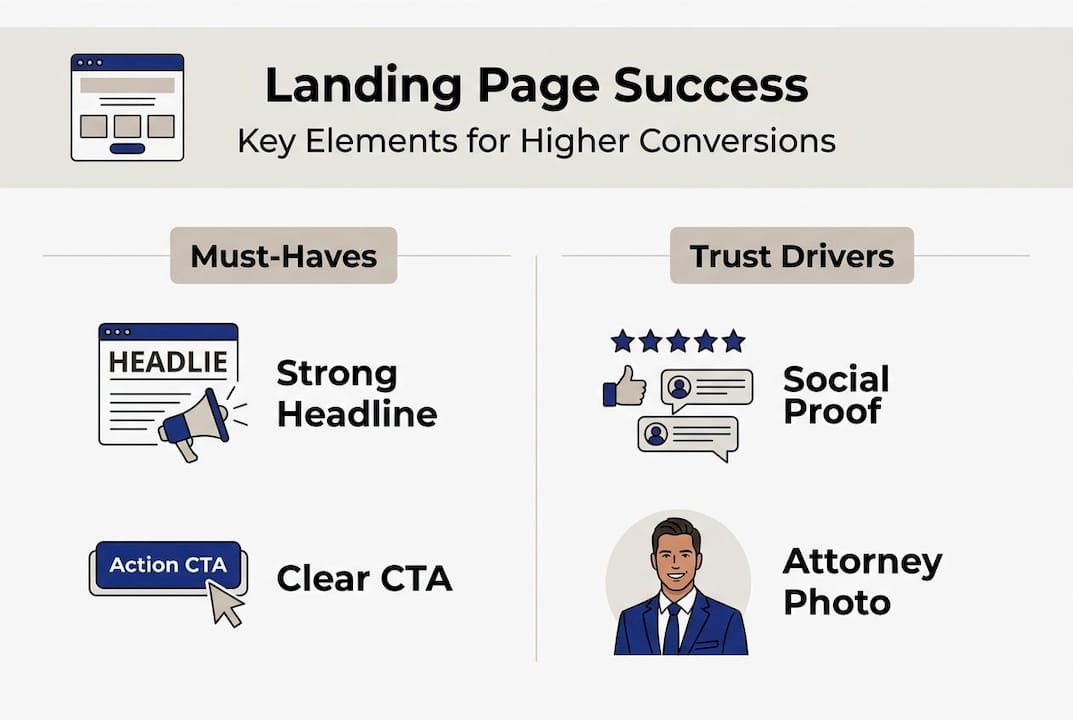
For a full checklist of what your page needs before launch, the website redesign checklist covers the technical and design elements that affect conversion. And if you want to understand how strategic website design connects to client acquisition, that context matters here too.
A/B testing and continuous improvement for legal landing pages
A landing page is never finished. The firms that consistently generate the most leads treat their pages as experiments, not finished products. A/B testing is how you find out what actually works, not what you think works.
Here’s a practical process for legal marketers:
- Set a clear goal. Before you test anything, define what success looks like. More form submissions? More calls? A lower cost per lead?
- Choose one variable. Test your headline first. Then your form length. Then your CTA. Never change two things at once or you won’t know what caused the result.
- Pick your tools. Platforms like Unbounce, HubSpot, and Google Optimize make it straightforward to run split tests without developer help.
- Run until you have enough data. Headline tests need 100 to 200 conversions before results are statistically meaningful. Don’t call a winner after 30 visits.
- Act on results and repeat. Once a winner is clear, implement it and move to the next variable.
For headline testing, try problem-focused versus outcome-focused versions. “Facing a DUI charge?” versus “Keep your license. Fight your DUI charge.” The second speaks to the outcome the visitor wants, which typically wins. Headline tests can produce a 34% lift in conversions, which is significant when you’re paying for every click.
Pro Tip: AI-powered tools like those built into HubSpot or Unbounce can now suggest variations based on your existing page data, shortening the time it takes to find a winning version. For legal practices with smaller traffic volumes, this speeds up the cycle considerably. Explore programmatic optimization strategies and testing tools to find the right fit for your firm’s setup.
Perspective: Why most legal professionals still miss the real landing page opportunity
Here’s the uncomfortable truth: most law firms that build landing pages still don’t get the results they should. Not because the page is ugly or the copy is bad, but because they stop at setup and never close the loop.
The real opportunity isn’t in the page itself. It’s in what happens around it. Empirical benchmarks confirm that legal landing pages excel because of urgent intent, but that intent evaporates fast. A prospect who fills out a form at noon and gets a call at 5pm has already moved on. That’s not a design problem. That’s an operations problem.
We also see firms that have no idea what’s happening beyond pageviews on their pages. They know traffic is coming. They don’t know where it’s dropping off, which form fields are causing friction, or whether mobile visitors are converting at all. Seconds matter in legal. A page that loads in 4 seconds instead of 1.5 seconds can cost you a client worth thousands in fees. The firms winning in legal digital marketing treat their landing pages like a revenue system, not a web design project.
Transform your legal marketing with proven landing page tactics
If this article made one thing clear, it’s that landing pages aren’t just a nice addition to your website. They’re one of the highest-leverage tools available to legal marketers in 2026.
We build high-performance WordPress websites and landing pages specifically for law firms and legal professionals across the US. From strategic website redesign to conversion-focused page builds, we handle the technical and design work so you can focus on clients. Whether your site needs a full overhaul or you want to learn how a WordPress site update can improve performance, we’re ready to help. Reach out to JDG Agency today to start turning your web traffic into signed clients.
Frequently asked questions
What is the main purpose of a landing page for law firms?
A landing page is built to drive one specific action, like booking a consultation or submitting a case inquiry, rather than serving as a general overview of your firm. Landing pages are designed around a single, compelling CTA that removes distractions and guides the visitor toward conversion.
How do law firm landing pages achieve higher conversion rates than other industries?
Legal visitors typically arrive with urgent, specific needs, which makes them far more ready to act than a casual browser. Optimized legal pages can reach 8% to 15% conversion rates by matching that urgency with a clear, focused offer.
What tools and methods should I use to test my landing pages?
Use platforms like Unbounce, HubSpot, or Google Optimize to run controlled A/B tests, changing one element at a time. Test one variable and wait for at least 100 conversions before drawing conclusions.
How important is speed of follow-up from landing page leads?
It’s critical. Rapid follow-up under 24 hours significantly increases the likelihood of converting a legal lead into a paying client, especially in competitive practice areas where prospects contact multiple firms at once.
Recommended
- Web Design, SEO & Digital Marketing Blog | JDG Agency
- Programmatic Advertising: Advanced Optimization for Higher Conversions
- Beyond the Aesthetics: The Strategic Imperative of Website Redesign Services for 2026 Brand Transformation – Web Design, SEO, Hosting & Servers |
- Website Redesign Without Losing SEO: 7 Mistakes That Could Tank Your Rankings (And How to Fix Them) – Web Design, SEO, Hosting & Servers |